

Kazuto Imura, Ai Degaito
“battery”
■Period
May 16th (Saturday), 2026 - June 20th (Saturday), 2026
*No opening reception on May 16
Wednesdays through Saturdays, 13:00 - 18:00
(closed on Sundays, Mondays, Tuesdays, and National Holidays)
*June 3 (Wed): temporarily closed due to the typhoon
■Venue
KANA KAWANISHI GALLERY
4-7-6 Shirakawa, Koto-ku, Tokyo 135-0021 JAPAN
*car parking available in front of the gallery
■Organizer
Kana Kawanishi Art Office LLC.
▼Talk Event
June 13 (Sat)2026 14:00-15:30
(Reception after the talk until 17:00)
Free / No reservation required (20 seats)
*Please note the talk will be conducted only in Japanese.
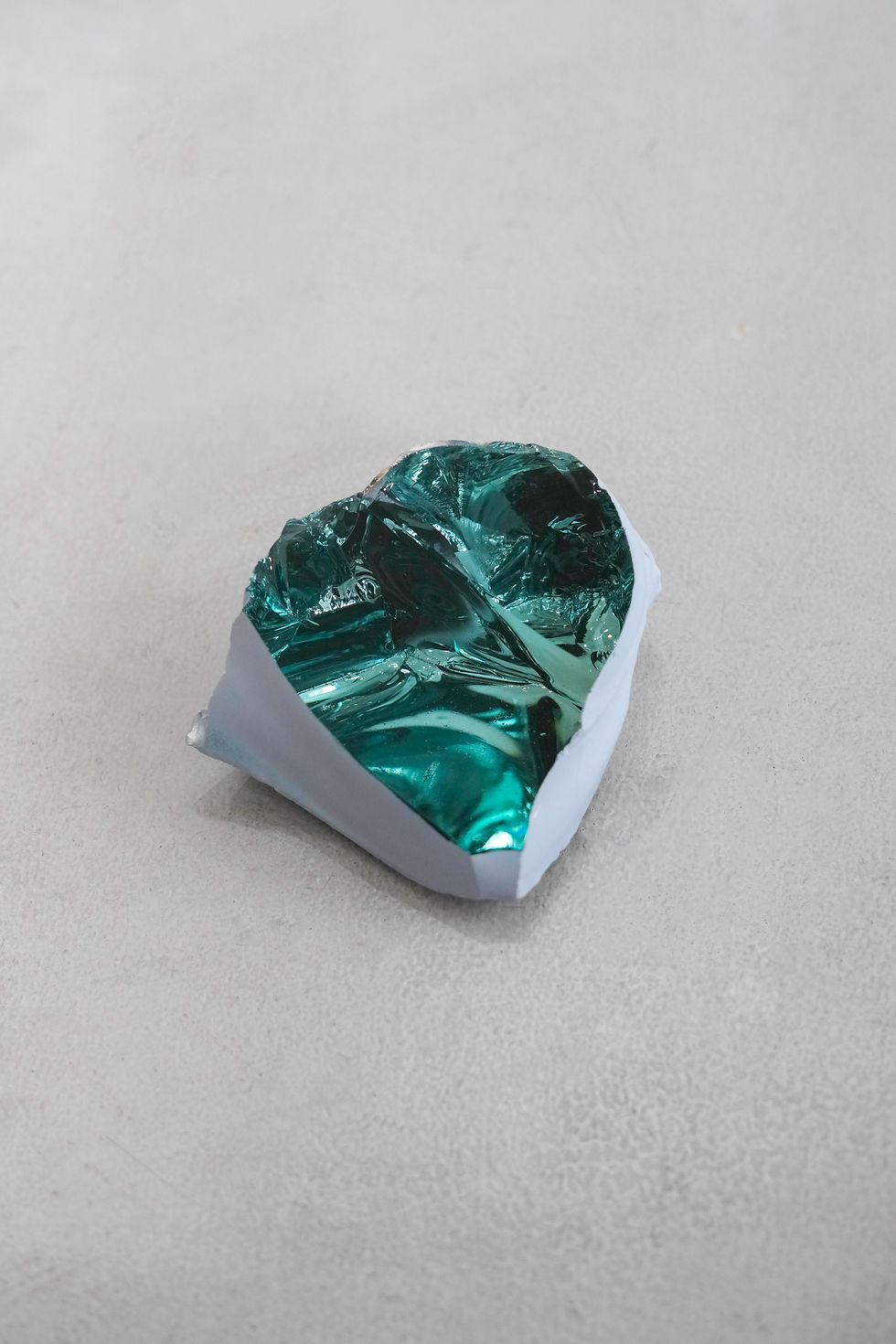
2025 | glass, aluminum | 62 × 148 × 159 mm | © Kazuto Imura, courtesy KANA KAWANISHI GALLERY
2025 | glass, aluminum | 62 × 148 × 159 mm | © Kazuto Imura, courtesy KANA KAWANISHI GALLERY
a solid fountain
2025 | glass, aluminum
62 × 148 × 159 mm
© Kazuto Imura, courtesy KANA KAWANISHI GALLERY

2026 | dose-packaging paper, obsidian, 50-year-old window glass, human hair ash, chicken bones, pork rib bone ash, eggshell ash, shell ash | 340 × 75 mm | © Ai Degaito, courtesy KANA KAWANISHI GALLERY
2026 | dose-packaging paper, obsidian, 50-year-old window glass, human hair ash, chicken bones, pork rib bone ash, eggshell ash, shell ash | 340 × 75 mm | © Ai Degaito, courtesy KANA KAWANISHI GALLERY
Legacy System (detail)
2026 | dose-packaging paper, obsidian, 50-year-old window glass,
human hair ash, chicken bones, pork rib bone ash, eggshell ash, shell ash | 340 × 75 mm
© Ai Degaito, courtesy KANA KAWANISHI GALLERY
KANA KAWANISHI GALLERY is pleased to present “battery,” a two-person exhibition featuring Kazuto Imura and Ai Degaito, opening Saturday, May 16, 2026.
Kazuto Imura’s practice began with deconstructing and reconstructing the structure of mirrors. From obsidian mirrors dating back to 620 BCE to modern vapor deposition techniques that bond metal to glass, he comprehensively explores the history of mirrors, their materials, and techniques. To him, a mirror is not merely a device, but an intelligence that has walked alongside humanity. By unraveling the history of mirrors through structural analysis, materials, and techniques, he can be said to serve as a spokesperson for all mirrors.
Ai Degaito has been familiar with ceramics and glazes since childhood and majored in materials thermochemistry, applied chemistry, and ceramics at university. After graduation, she honed her skills in ceramic-producing regions such as Shigaraki and Okinawa. Witnessing firsthand the reality of “eternity that does not return to the earth”—where pottery, once fired by flame, cannot return to the earth and is instead discarded in mountains of waste—she began exploring sustainability in ceramic expression. Through material selection and the glazing process, she pursues a unique form of expression that fixes and represents “communication with others” and “the memory of materials” within the glaze.
This exhibition features an all-new collection of works and is structured around a framework of mutual reference: “Imura curates Degaito, and Degaito curates Imura.” Through this structure—which offers a meta-perspective on the “mirror” that Imura continually pursues—the two artists resonate with each other’s essence. By allowing their works to be “shaped by the material,” they generate a new chemical reaction in artistic expression.
Imura’s new work, a solid fountain, incorporates the mythical imagery of Narcissus—which he has been exploring in recent years—into his established mirror in the rough series, which uses discarded glass blocks that failed to become mirrors in the factory. Degaito applies heat treatment to the glass blocks in a kiln, gently softening the entire piece to remove scratches and stains while preserving its original shape and characteristics. Through further polishing and a mirror finish, the glass is finally transformed into a mirror. Imura comments on this work as follows:
This mirror is a solid fountain. It exists as a water surface for Narcissus. The redemption of glass that could not become a mirror and the redemption of preventing Narcissus from drowning in the water are bound together within a single structure.
Degaito’s new work, Legacy System, originates from the clinic once run by her grandfather. By sealing fragments of various materials fired by Degaito into a pill-packaging machine left behind in the clinic—which once dispensed prescriptions on-site—the installation assumes a narrative quality, as if each material were stored in its own pouch, waiting to be opened.
We cordially invite all to this exhibition, where two artists who have deeply engaged with materials and the act of creation draw out new power through the curation of each other’s work.
 “Relic of the Star”2025 | grass ash (houttuynia cordata and others), bone ash, tobacco, Fukushima feldspar, copper, chromium, zinc oxide, manganese dioxide | 80×120×125 mm | © Ai Degaito, courtesy KANA KAWANISHI GALLERY | 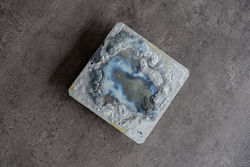 “Mirror”2024 | shelf board (carborundum), weeds, copper, soda bottle, studio debris 10×250×250 mm | © Ai Degaito, courtesy KANA KAWANISHI GALLERY |
|---|---|
 “Legacy System”2026 | dose-packaging paper, obsidian, 50-year-old window glass, human hair ash, chicken bones, pork rib bone ash, eggshell ash, shell ash 340 × 75 mm | © Ai Degaito, courtesy KANA KAWANISHI GALLERY |
Artist Statement
On Kazuto Imura (by Ai Degaito)
In 2024, I became acquainted with Imura’s work. In wall-ordered, I discerned a keen interest in the visual through the intersection of Imura’s own “seeing/being seen,” and I sensed his underlying complexes in the way he constructed the theme of narcissism using a mirror-like structure.
In his solo exhibition that same year, 10 Ways for Narcissus Not to Die, he replaced metaphorical motifs with his self-portraits (the archive is not publicly available)—that is, he placed the artist himself at the center of the work. Before even considering whether this could be called art, I saw the courage to confront the self.
At the same time, I felt that his past works, much like the solo exhibition, eloquently conveyed the emotions—such as the complexes Imura himself harbored—but I also saw the anguish he felt, knowing that these feelings could not be conveyed unless he expressed them directly or put them into words. As a fellow artist, I deeply empathized with him.
On the other hand, since 10 Ways for Narcissus Not to Die, his complexes have faded from his words and actions. In bulbocodium (2026), he used almost no mirrored materials, suggesting a creative stance that turned toward others rather than the self. It appears that Imura himself has begun to take on the role of the mirror.
In this work, Imura transforms his past pieces—which he created for his own salvation—into an attempt to save others. I hope this text serves as a guide for viewing his works.
Ai Degaito
* * *
On Ai Degaito (by Kazuto Imura)
Ai Degaito’s glazes—created by blending materials found in her surroundings and carefully controlling heat—differ from off-the-shelf glazes; they exist as something unique, refined through meticulous procedures yet defying standard formats. Her work is candid, yet quietly resonates with social issues.
Whether to leave a trace of existence or not—giving that choice of destiny to the material that has become glaze. Clay is rapidly disappearing. She is now creating works using sustainable materials such as shelf boards, or clay made by mixing soil collected from earthen walls with bacteria.
Her work demonstrates that, unlike earth, glaze can melt, flow, and transform into something else. As long as the Earth remains in this state, the thoughts imbued in every glaze will continue to exist, and can change form as many times as people desire. This allows us not only to leave a mark, but also to pass on the choice of transformation.
By being passed on to others, it continues to exist while holding the potential to keep changing.
Kazuto Imura
Artist Profile
Kazuto Imura was born in 1990 in Kyoto, Japan. He received his B.F.A. from Kyoto City University of Arts in 2015. He completed his M.F.A. at Tokyo University of the Arts, the Graduate School of Fine Arts, Department of Intermedia Art in 2017.
Only one can know one’s inner self, while only others can see one’s outer appearance. Mirror images and photographs are images of re-presentation of appearances, not themselves. In other words, there is no one who knows both the inside and the outside. Interested in this fact, Imura creates works on the theme of showing others the mirror that contains himself. He explores materials and techniques such as optical devices, non-reflective mirrors, magic mirrors, obsidian, and rotating liquid mirrors. He traces the transition of the relationship between humans and mirrors from contemporary science and engineering to mythology and rituals.
His recent solo exhibitions include “commission work” (2024, Kanda & Oliveira, Chiba, Japan), “10 Ways for Narcissus Not to Die” (2024, Studio Ghost, Tokyo), and “The N-Lemma Posed by Compromise” (2024, KANA KAWANISHI GALLERY, Tokyo).
Group exhibitions include “Contemporary Art in Seto: Touch the Bottoms” (2024, International Art Festival “Aichi” Regional Development Project, Aichi, Japan), “MATSUMOTO Architecture + Art Festival” (2023 & 2022, Nagano, Japan), “Endless Green Mountains 3: The Tang Poetry Road, a Special Exhibition of Works by Chinese and Japanese Artists” (2022, Zhejiang Exhibition Hall, Zhejiang, China) and “Sense Island Sarushima Dark Museum 2021” (2021, Sarushima, Kanagawa, Japan).
* * *
Ai Degaito was born in Asuka Village, Nara, Japan. She studied ceramics and materials thermochemistry at college and ceramic facilities in various regions. Her practice centers on granting objects the choice of whether traces of existence should “remain” or “not remain.” She burns materials that hold a human sense of distance—such as plants, bones, household waste, and personal belongings—and refines glazes using only their ashes. Holding the conflicting sensations of “the terrifying eternity of what does not return to the soil” and “the preciousness of objects as devices of memory,” she pursues the concept of the “archive,” which inscribes time indefinitely while transforming personal memory.
Her recent solo exhibitions include “Sincere Memory, Glaze” (2025, Suzusan Galerie Raum, Aichi, Japan), “And you” (2024, JITSUZAISEI, Osaka, Japan), and “Voice” (2023, JUU arts & stay by FIGYA, Osaka, Japan).
Group exhibitions include “BankART Alive! Exhibition – Recommended Artist Section” (2025, BankART Station, Kanagawa, Japan).
Degaito has also undertaken commissioned works for buildings owned by Mitsubishi Estate Co., Ltd.
>> 日本語PDF
>> English PDF