

Group Exhibition
“Seen, Remembered, Unmake”
▼OPENING RECEPTION
February 14th (Saturday), 2026 17:00-18:00
■Artists
Naruki Oshima, Kazuhito Tanaka, Atsushi Aizawa, Tamami Iinuma, Rimi Arimoto
■Period
February 14th (Saturday), 2026 - March 7th (Saturday), 2026
Wednesdays through Saturdays, 13:00 - 18:00
(closed on Sundays, Mondays, Tuesdays, and National Holidays)
■Venue
KANA KAWANISHI GALLERY
4-7-6 Shirakawa, Koto-ku, Tokyo 135-0021 JAPAN
*car parking available in front of the gallery
■Organizer
Kana Kawanishi Art Office LLC.
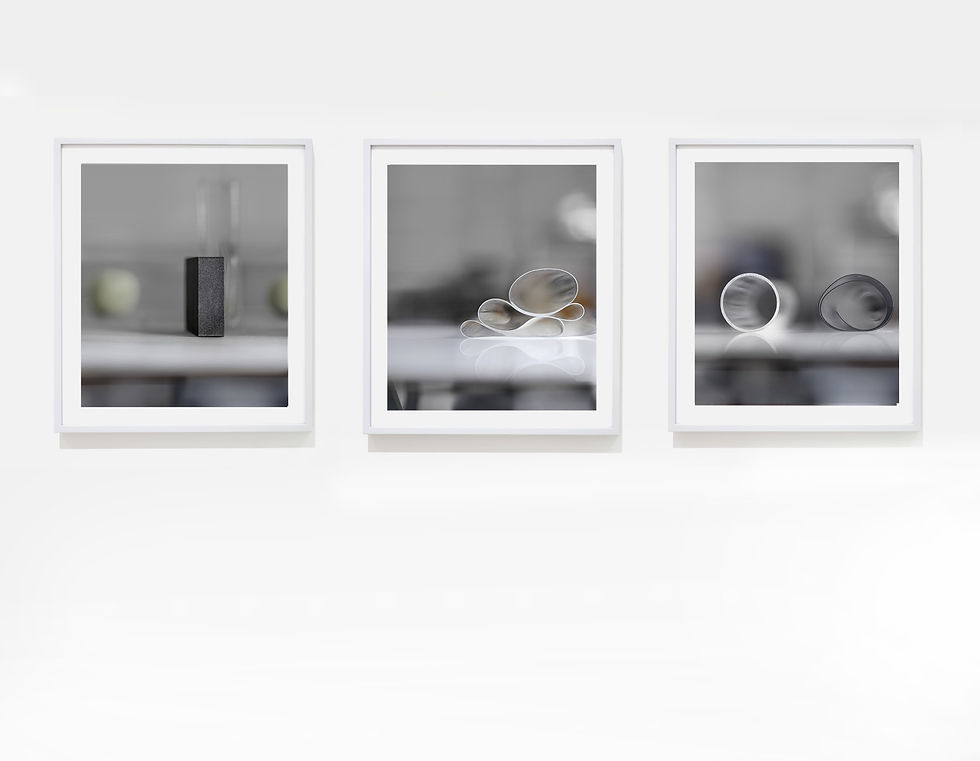
“Still Life on a Table—Black Surface with Two Green Balls / Soft Circles with Orange / Two Distinct Circles Between” 2024/2025 | focus-collaged archival pigment print in acrylic mounted frame | 470 × 410 mm each © Naruki Oshima, courtesy KANA KAWANISHI GALLERY
“Still Life on a Table—Black Surface with Two Green Balls / Soft Circles with Orange / Two Distinct Circles Between” 2024/2025 | focus-collaged archival pigment print in acrylic mounted frame | 470 × 410 mm each © Naruki Oshima, courtesy KANA KAWANISHI GALLERY
Still Life on a Table—Black Surface with Two Green Balls / Soft Circles with Orange / Two Distinct Circles Between
2024/2025 | focus-collaged archival pigment print in acrylic mounted frame | 470 × 410 mm each
© Naruki Oshima, courtesy KANA KAWANISHI GALLERY
KANA KAWANISHI GALLERY is pleased to present the group exhibition, “Seen, Remembered, Unmake,” opening Saturday, February 14, 2026.
“Seen, Remembered, Unmake” is an exhibition that explores the creation and dissolution of images through acts of extraction, seeing, exploring perspectives, or remembering/tracing memory. Five artists, each employing their own techniques and languages, weave together their subjects and traces of memory, visualizing the processes of reconstruction and unmaking brought about by seeing and remembering. Memory is not only preserved but also edited, dismantled, and reshaped—the exhibition focuses on these subtle transformations and the spaces between.
* * *
 “Still Life on a Table—Black Surface with Two Green Balls”2024/2025 | focus-collaged archival pigment print in acrylic mounted frame | 470 × 410 mm | © Naruki Oshima, courtesy KANA KAWANISHI GALLERY |
|---|
 “Still Life on a Table—Soft Circles with Orange”2025 | focus-collaged archival pigment print in acrylic mounted frame | 470 × 410 mm | © Naruki Oshima, courtesy KANA KAWANISHI GALLERY |
 “Still Life on a Table—Two Distinct Circles Between”2025 | focus-collaged archival pigment print in acrylic mounted frame | 470 × 410 mm | © Naruki Oshima, courtesy KANA KAWANISHI GALLERY |
Naruki Oshima was born in Osaka in 1963. Guided by the concept of seeing—establishing a new relationship with the world—he primarily employs photography as his medium. Through methods that disrupt perspective, he introduces shifts in the interpretation of everyday spaces, creating expressions that amplify the light, color, and tactile sensations that constitute the image of his subjects. This exhibition features works created during his recent extended research residencies in Düsseldorf and Helsinki. Using a close-up photographic technique called the focus collage, he exploits differences in depth of field to depict the ‘emergence of parts.’ Through the tactile quality of surfaces and the materialization of light, he presents moments where meanings arise between multiple motifs.
* * *
 “PP #15”2020 | oil, acrylic, and analog chromogenic print on canvas (with acrylic frame) | 663 × 514 × 33 mm (frame size) | © Kazuhito Tanaka, courtesy KANA KAWANISHI GALLERY |
|---|
 “PP #21”2020 | oil, acrylic, and analog chromogenic print on canvas (with acrylic frame) | 736 × 541 × 33 mm (frame size) | © Kazuhito Tanaka, courtesy KANA KAWANISHI GALLERY |
Kazuhito Tanaka was born in Saitama in 1973. After graduating from Meiji University, he moved to the United States and earned a degree from the School of Visual Arts (NY). He creates works exploring the relationship between photography and painting, employing photograms and abstract expression. For this exhibition, he presents the series PP, in which color photogram prints are placed on the color fields of abstract paintings on canvas. Through the intersection of photographic traces and painterly composition, he attempts to reorganize memory and vision.
* * *
 “Origin #43”2020 | magnetic paint on canvas | 785 × 1243 × 42 mm | © Atsushi Aizawa, courtesy KANA KAWANISHI GALLERY |  “Origin #43” (detail)2020 | magnetic paint on canvas | 785 × 1243 × 42 mm | © Atsushi Aizawa, courtesy KANA KAWANISHI GALLERY |
|---|---|
 “Origin #43” (detail)2020 | magnetic paint on canvas | 785 × 1243 × 42 mm | © Atsushi Aizawa, courtesy KANA KAWANISHI GALLERY |
Atsushi Aizawa was born in Kanagawa in 1991. Aizawa studied Japanese painting and media arts at Tama Art University. He continues to visualize invisible forces by incorporating the natural properties of materials, such as magnetism and rust. He has gained attention for his body of work that fuses Japanese painting’s sense of color with media technology, layering the mechanics of nature with layers of memory. For this exhibition, he will present a new magnetic painting created on-site at the gallery.
* * *
 “Französische Straße”from the series “JAPAN IN DER DDR - Gestohlene Erinnerungen wurden erneut zerstört” | 2016 | type c print | 178 × 126 mm | © Tamami Iinuma, courtesy KANA KAWANISHI GALLERY |  “Behren Straße”from the series “JAPAN IN DER DDR - Gestohlene Erinnerungen wurden erneut zerstört” | 2016 | type c print | 178 × 126 mm | © Tamami Iinuma, courtesy KANA KAWANISHI |
|---|---|
 “unbekannt, Mitte”from the series “JAPAN IN DER DDR - Gestohlene Erinnerungen wurden erneut zerstört” | 2016 | type c print | 126 × 178 mm | © Tamami Iinuma, courtesy KANA KAWANISHI GALLERY |
Tamami Iinuma was born in Tokyo in 1983. She has been presenting her work in both Europe and Japan, logically constructing the mediums of architecture, photography, and publishing through her own body. This exhibition presents a portion of Chapter 4: Gestohlene Erinnerungen wurden erneut zerstört (The memory that was deleted twice) from the series Japan in der DDR - Gestohlene Erinnerungen wurden erneut zerstört. Inspired by an incident in the 1970s in which burglars broke into the construction office of a hotel under construction by Kajima Corporation in East Germany, stealing only the 35mm film while the camera body remained in the safe, Iinuma photographed the surrounding site herself using 35mm film. However, after returning to Japan and sending the film for development, a malfunction in the developing machine caused the photos to fade to white. These two incidents may appear coincidental at first glance, but upon closer inspection, the first was likely carried out by a Stasi spy, given the historical context at the time, and the second was essentially caused by human error. The memory did not naturally disappear but was literally deleted twice.
* * *
 “Patterning View”2024 | single-channel video | size variable | © Rimi Arimoto, courtesy KANA KAWANISHI GALLERY |  “Patterning View”2024 | single-channel video | size variable | © Rimi Arimoto, courtesy KANA KAWANISHI GALLERY |
|---|---|
 “Patterning View”2024 | single-channel video | size variable | © Rimi Arimoto, courtesy KANA KAWANISHI GALLERY |
Rimi Arimoto was born in Kanagawa in 2001. She graduated from Tama Art University’s Department of Painting, Printmaking Major, in 2024 and is currently expected to complete her Master’s program at the same university in 2026. Centered on video works and print expressions, her practice explores concepts such as gaze, time, passage, perception, sensation, and layers. She investigates how discrepancies between observation and memory, and overlapping layers of information, transform the viewer’s perception. In this exhibition, she plans to exhibit video works that reexamine the temporal and layered structure of visual experience.
* * *
This exhibition presents expressions extracted from the acts of seeing, remembering, and unmaking, creating a space where the distinct techniques and approaches of five artists intersect. It aims to evoke new perspectives and sensibilities through the very process of unraveling and reorganization—specifically, through the freshness, gaps, and transformations inherent within it.
>> 日本語PDF
>> English PDF